The field guide · Cross-country running
Your first cross-country race: club entry, individual entry or championship?
By James Thompson · Updated 29 October 2026
Some links in my articles are affiliate links. I may earn a commission when you buy through them.

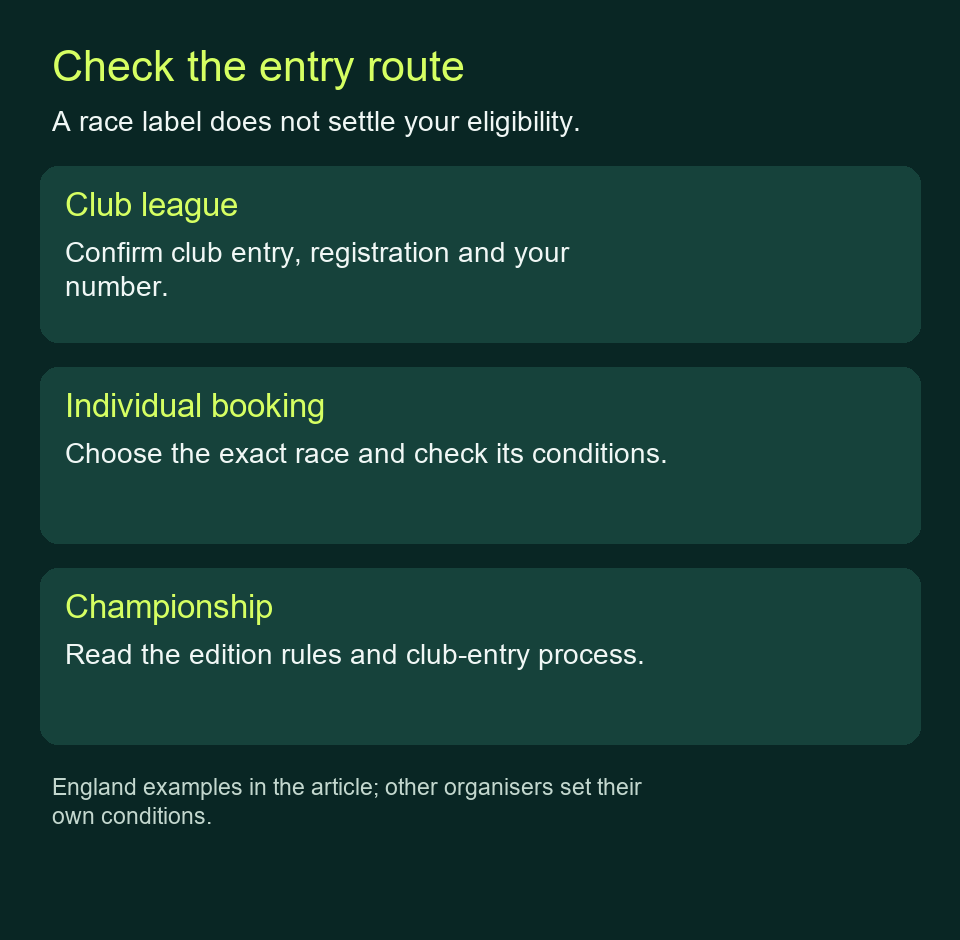
If your club runs cross-country, start with its team manager: the club may handle registration and numbers for you. If you enter an event yourself, check the exact race and its eligibility first. A guest place may still require club membership, and the shortest race on a timetable can be a selection trial with performance standards.
This guide uses England-based examples checked on 29 October 2026: Mid Lancs’ 2026/27 season, Liverpool’s November 2026 event and an explicitly historical National Championship entry procedure. Other UK nations and organisers have their own arrangements.
Table of Contents
ToggleChoose the entry route before choosing a distance
| Route into a race | What to establish | Example |
|---|---|---|
| Your club’s league team | Who registers you, athlete registration, vest and number. | Mid Lancs 2026/27 uses a team-manager entry process. |
| A guest place in a league | Whether “guest” includes your actual membership status. | Mid Lancs guests belong to affiliated clubs outside that league. |
| An individual event booking | The exact race, category and entry conditions. | Liverpool has separate senior league and Cross Challenge/trial races. |
| A championship entry | Club affiliation, individual eligibility and the edition’s entry procedure. | The 2026 English National accepted entries through eligible clubs. |
Sources: Mid Lancs entry information, its 2026/27 rules, Liverpool’s official event page and the 2026 National entry procedure. An entry portal lets you book; it does not establish that every listed race suits your experience.
A club league is a good place to begin the conversation
The Mid Lancs rules require each competing club to have a team manager who makes the initial entry and distributes numbers. They also require club vests and national-association athlete registration, including for guests. Ask your club whether you are registered and which race you should run before assuming your ordinary club subscription completes the process.
A league fixture gives you a club contact who can explain the course, meeting point and the practical routine. Ask about the ground and climbs, lap count, how much time you need before the start and where to leave warm clothes. You can get those answers before deciding whether this is the right first outing.
The current league page says entries must be made in advance, with no facility to enter on race day. A normal Mid Lancs season number is retained between fixtures, but Liverpool is an exception. Check which number you need for that fixture rather than simply arriving with the one used last time.
Mid Lancs also defines a guest more narrowly than “someone who is not in a club”: the guest belongs to an England Athletics-affiliated club that is outside the league. If you are unattached, look for explicit acceptance of unattached runners elsewhere or discuss joining a suitable club. Do not use the guest label as proof you qualify.
Liverpool shows why the exact race matters
British Athletics’ 2026/27 announcement places Liverpool at Sefton Park on 28 November 2026. The event timetable separates senior Cross Challenge/European trial races from senior league races later in the day. The published senior distances are 8km, yet the starts are different:
| Senior category | Cross Challenge / trial start | League-race start |
|---|---|---|
| Women | 11:00 | 13:00 |
| Men | 11:40 | 14:10 |
Use those as dated examples of two entries sharing a venue and headline distance. A league runner should get the correct entry route and start from their team manager; a personal booking for the earlier race is a different decision. Check the final timetable and start list for your actual entry.
The organiser-linked booking page also lists short-course races. For 2026 it specifies men’s standards below 4:30 for a mile or 4:10 for 1500m, and women’s standards below 5:00 or 4:40 respectively. Those are short-course entry conditions, not a pace requirement for every Liverpool race. Choosing the smallest distance on the screen would miss the purpose of that race.
A championship can admit more runners than it needs to score
The 2026 English National procedure required entry through clubs affiliated to England Athletics for cross-country, with athlete registration and individual eligibility conditions. It also stated that all accepted entrants could run: the number needed to produce a team score was not a cap on participation.
For example, that edition listed four scorers for senior women and six for senior men. A club having those places covered did not mean every additional accepted runner had to stay at home. Check with the team manager about eligibility and the club’s own arrangements.
That National took place on 21 February 2026. Its page illustrates the process; it is not the final instruction for a future championship. Read the new edition’s rules before carrying forward its categories, distances or deadlines. The team-scoring guide explains what scorers and additional finishers do.
Match the course to the running you already do
Once the entry fits, read the actual course instructions. Ask about surface changes, climbs and descents, lap routes, crossings and what happens if you need to stop.
The ordinary Mid Lancs timetable gives approximate senior distances of 6.5km for women and 9–10km for men; the Liverpool timetable publishes 8km for both senior league races. Even within the same season, the fixture changes the distance you are preparing for. Use its own map and instructions.
If the appeal is steep hill running and route choice rather than joining a league race, compare the first fell-race options separately. Their ground and navigation demands need a different assessment.
Settle these details before race day
Confirm who enters you, which category and start you are in, where your number comes from, what you must wear or carry, and how to report if you retire. For Liverpool, use its separate fixture instructions: the Mid Lancs page’s late-registration note contains a date that does not line up with the advertised portal opening. Get the current arrangement rather than relying on that deadline.
Plan the arrival and finish as well as the race. The race-day packing checklist helps keep your number, warm layers and return-travel essentials accessible. Use the organiser’s own eligibility and kit instructions when you finalise your list.