Some links in my articles are affiliate links. I may earn a commission when you buy through them.
For a first fell race, start with a course whose ground, descent and route-finding demands you understand. Rivington Pike and the short Loughrigg race are worth investigating if you already enjoy steep off-road running. Loughrigg Silverhow asks considerably more: its published listing requires experience and navigation skills, even though it starts near the same place as Loughrigg.
A short race can put a steep climb and a demanding return descent into a few kilometres. Someone comfortable on long, smooth trails may find that a bigger change than adding more distance.
The examples here use published 2026 information, checked on 26 October 2026, and attributed reports from earlier editions. They explain different kinds of fell-race day; they are not a list of forthcoming entries. Use the organiser’s next-edition information before booking or planning a recce.
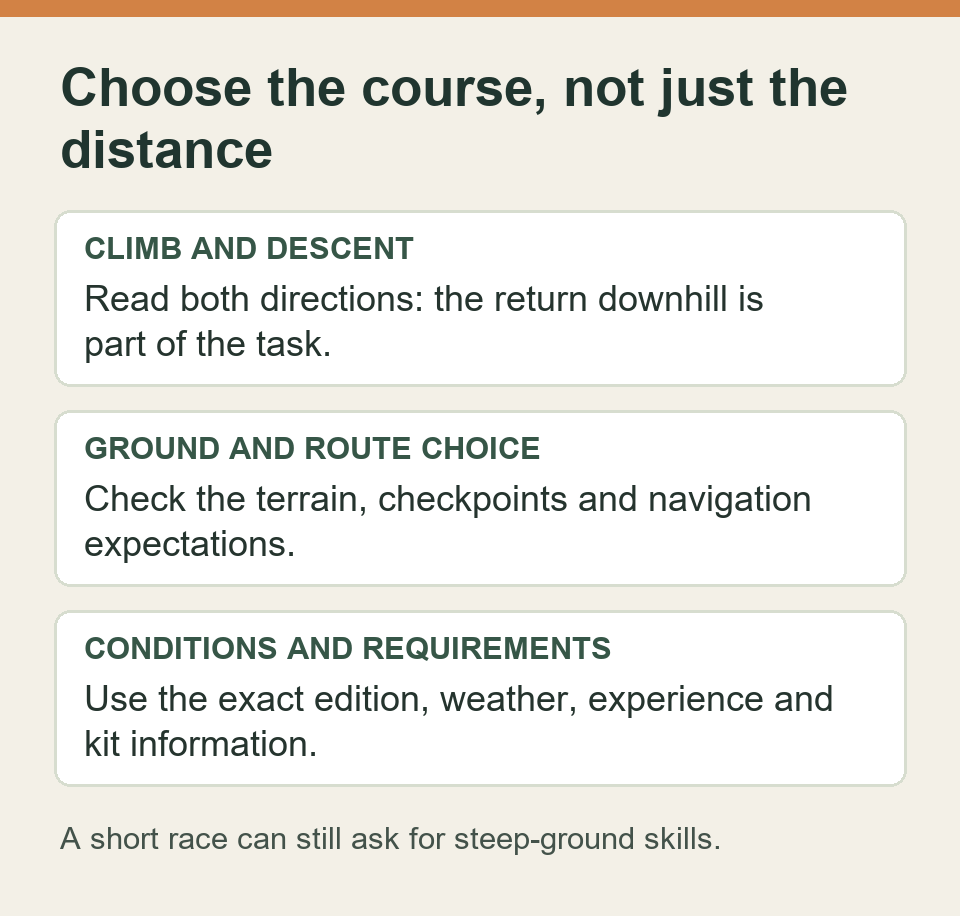
Read the ground, descent and route requirements alongside the headline distance.
These are English fell races. The FRA governs fell racing in England and the Isle of Man, while other UK associations and individual events have their own rules. The FRA introduction describes a sport that can include pathless ground, steep climbs and descents, and self-navigation. A familiar trail-race label does not tell you all of that.
Treat a race page as a description of the job: what happens on the climb, where the surface changes, what you must find, and how you return.
Three published course examples
Race and published category
Distance and climb
Main decision for a prospective entrant
Rivington Pike — BS
5.2km; 800ft of ascent (about 244m)
A short up-and-down outing with the climb concentrated within the route. Look closely at the descent.
Loughrigg — AS
6.4km; 330m
A short Lakeland out-and-back with changing surfaces and a rough summit approach.
Loughrigg Silverhow — AM
14km; 880m in the FRA listing
A longer route-choice event with experience, navigation and local-knowledge flags.
Rivington Pike: a compact race with a proper descent
Horwich Harriers describes an up-and-back route to Rivington Pike from near the Crown Hotel in Horwich. Its 5.2km and 800ft figures suggest a compact outing, but much of that distance has to accommodate getting to the hill and returning. You should expect the uphill section to feel different from spreading the same ascent across a long trail loop.
The Steel City Striders account of the March 2024 race describes road, muddy woodland, gravel and grass before the stony summit approach. It also describes faster leaders descending while others were still climbing.
Rivington is worth investigating if you want to try an up-and-down race and can already move confidently on steep off-road ground. Read the current route and marshal instructions, including how runners share the course. Being able to run 5km on a flat path does not answer how you will handle the descent.
If downhill footing is the part you have barely practised, spend time on suitable hills with a local fell-running group before using a race as your introduction to it. Ask the organiser whether your experience fits the current course.
Loughrigg: the short race is a succession of different surfaces
Ambleside AC’s short Loughrigg description starts from Rothay Park, climbs a tarmac road and then a gravel track, before turning onto the fell. It describes short climbs, runnable stretches, a pitched path and a rocky summit approach, followed by a return along the route. The advertised 6.4km carries 330m of ascent.
This could appeal if the attraction is a short Lakeland outing with variety underfoot. The practical question is how you feel when a runnable section gives way to a steeper or rougher one. Study the return as carefully as the climb.
The published 2026 event was an evening race. Ambleside explicitly identifies limited light as an additional concern in its entry information. Check the timing and requirements for the edition you intend to enter rather than assuming a short distance means daylight is irrelevant.
Choose the short Loughrigg page deliberately when researching. Searching only for the hill’s name can also lead to Loughrigg Silverhow, a materially different undertaking.
Loughrigg Silverhow: similar starting area, a much bigger commitment
The 2026 FRA entry lists 14km, 880m and the flags ER, LK and NS: experience required, local knowledge an advantage and navigational skills required. The organiser’s page describes visits to Loughrigg, Silverhow and Lily Tarn, plenty of route choice, full FRA kit and an initial Loughrigg checkpoint cut-off.
The organiser expresses the route as 8.5 miles and 2,900ft, while the FRA uses the metric pair above. Treat those as approximate descriptions from their respective sources. A more consequential detail is the 2026 first-checkpoint cut-off of 35 minutes: check any future edition’s published requirement rather than planning around a possible relaxation.
In Lostock AC’s February 2026 report, Dan describes slippery and boggy ground, several route choices and the value of a clubmate’s guidance on his first Lakeland fell run. He ends by identifying map-reading and navigation as skills he wants to improve.
Keep this as a later option unless you already meet the organiser’s experience requirements and can handle the navigation independently. Having completed the short Loughrigg race would not, by itself, establish that.
Match the next challenge to your experience
These are conditional shortlists, not assessments of individual runners:
You run steep local trails and want a compact race: investigate Rivington Pike’s current route and descent. Compare the ground with hills you already know.
You want a short Lakeland race and enjoy changing surfaces: investigate the short Loughrigg event, including its summit approach, timing and current kit instructions.
You want a longer outing involving route choice: read the Silverhow requirements first. Check that your actual fell and navigation experience meets them before considering entry.
Your experience is mainly smooth trails or roads: try local fell-running sessions and navigation practice before choosing a course from its distance alone.
Our fell-race navigation guide explains markings, GPS restrictions and the questions to resolve before entering. Once the course fits your experience, read the organiser’s complete requirements and plan around them.
The UK Race Atlas can help you explore events by location. Its coverage is still developing; use the organiser’s current page for the final route, eligibility, kit and entry details.