Some links in my articles are affiliate links. I may earn a commission when you buy through them.
In the Mid Lancs position-scoring system, add the finishing places of the runners who count for your team: the lowest total wins. Additional runners keep their places in the result and can push a rival’s scorers back. How many runners count depends on the category and competition.
The examples below use the league’s published 2026/27 rules, checked on 29 October 2026. The worked results are hypothetical. Check your own league or championship before applying its scoring number, guest treatment or tie-break.
The Mid Lancs 2026/27 rules specify three scorers for senior women and six for senior men. Veteran categories have their own numbers: for example, Vet 40 men use four. Do not borrow a teammate’s scoring number without checking which team category they mean.
Competition and category
Runners to count
Mid Lancs 2026/27 senior women
3
Mid Lancs 2026/27 senior men
6
Mid Lancs 2026/27 Vet 40 men
4
English National 2026 senior women
4
English National 2026 senior men
6
The National figures come from the 21 February 2026 entry procedure, a past-edition example. They show why a familiar club team can use a different scoring number at a championship; they are not confirmation of the next edition’s rules.
Add places, not finishing times
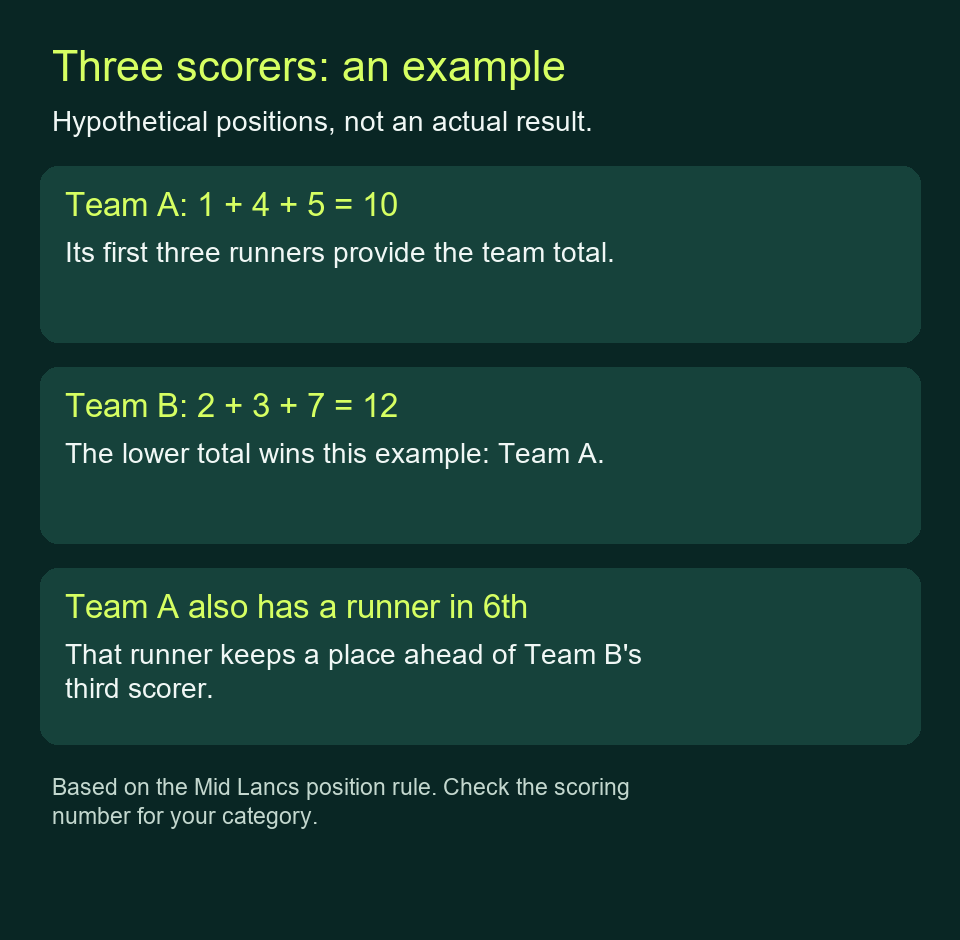
Suppose a category has three scorers. Team A’s first three eligible runners finish 1st, 4th and 5th. Team B’s finish 2nd, 3rd and 7th. A has 10 points; B has 12. A wins this comparison, even though B has two runners ahead of A’s second scorer.
The gap in seconds does not enter that position sum. Gaining a place reduces that runner’s own position contribution by one. The team’s net change depends on who is passed: exchanging places with a teammate can leave the team total unchanged.
Hypothetical positions under the Mid Lancs rule, not an actual race result.
An extra runner can change a rival’s total
Now include a fourth Team A runner in 6th. That place does not join A’s three-scorer total, but it stays in the order ahead of B’s third scorer in 7th. Rule 11 explicitly retains non-scoring team members’ positions when computing other teams’ totals.
Remove that extra A runner from this hypothetical finish order and B’s third scorer moves from 7th to 6th. B’s total would become 11 instead of 12. A’s first-three total remains 10.
The effect has a limit: a runner finishing behind every B scorer would not push those scorers back. Nor should you assume a guest is treated exactly like an eligible team member. Check the competition’s result and eligibility rules before counting either effect.
A tie can come down to the last scorer
Mid Lancs breaks equal race-position totals by comparing the final scoring member of each tied team. The one closer to first place wins.
For another three-scorer example, Team A finishes 1st, 4th and 8th: 13 points. Team B finishes 2nd, 5th and 6th: also 13. B wins the tie because its last scorer is 6th, ahead of A’s 8th. The extra places in this hypothetical field can belong to other teams.
Do not replace this with a comparison of total times or the teams’ first runners. A season-long tie has a different published procedure, and another competition may set a different race tie-break.
Separate a race total from league-table points
After calculating the race order, Mid Lancs awards points towards the league standings. For example, a senior men’s team winning in Divisions 1–3 receives seven league points, while a Division 4 win receives ten. These rewards are different from the sum of its six runners’ finishing places.
So a low position total is good in the race, while a higher award of league points is good in the season table. Read the column heading before comparing two numbers that happen to appear in the same results file.
The league rules give zero league points to a club that does not complete a team. They nevertheless retain non-scoring members’ places in other teams’ position totals, whether their own team is complete or not. A team finishing one runner short and a team with a very high completed score are different outcomes.
What this means when you are new to the team
Ask which category you can score in and how many finishers the club needs. If you complete an otherwise incomplete team, your finish can make a difference even when your own placing is near the back. If you are beyond the scoring places, you can still affect rivals whose scorers finish behind you.
If you need to stop, follow the event’s retirement instructions and let the team manager know; accurate participation information matters when the club checks its result.
For a first outing, settle eligibility, entry and your actual start with the cross-country entry guide.