Some links in my articles are affiliate links. I may earn a commission when you buy through them.
For an FRA fell race, plan to know where you are going without relying on other runners or GPS navigation. Some sections may be flagged, but a few markers and compulsory checkpoints do not establish a continuously marked route. If you want to follow a marked trail course, confirm that arrangement with its organiser before choosing an event.
This guide concerns FRA-registered racing, principally in England and the Isle of Man. Check the governing rules for races elsewhere and for other event formats; a familiar GPS routine from a trail race may not be permitted.
The FRA FAQ says runners remain responsible for navigation even when NS is absent from the listing. Establish whether the route is fixed, which checkpoints must be visited and which sections are compulsory. A course may combine mandatory sections with a choice of lines elsewhere.
A marker at a crossing can answer “Where do I pass this fence?” without answering “Which line do I take across the next fell?” Ask about the space between the published points as well as the points themselves.
The Loughrigg Silverhow organiser’s description is a useful example: it explicitly mentions route choice and recommends a recce. An out-and-back description does not automatically remove decisions, particularly when the route revisits a broad hilltop from another direction.
Before entering, check the map, written route, boundaries and crossing instructions for the actual edition. If a diagram is unclear, ask for clarification rather than assuming a line on an unrelated walking map is the race route.
Understand the GPS rule before choosing your watch screen
Device use in an FRA race
What the published guidance says
Your practical check
Time, speed, distance or altitude display; recording a route
The organiser requirements allow these uses.
Check for stricter event instructions and choose an appropriate display.
GPS route following or position fixing
Prohibited, including a momentary position check.
Do not use breadcrumb guidance, a location map or off-route navigation prompts.
Electronic compass
The FRA FAQ prohibits its use.
Use the required traditional compass, not a watch compass screen.
Navigation device used in an emergency
The FAQ requires retirement and reporting to the organiser.
Get the help or information you need, then follow the event retirement procedure.
Sources: the FRA organiser requirements and official kit FAQ, checked 26 October 2026. Carrying a device and using it to navigate are different questions. If an event restricts what may be carried, follow that instruction too.
Before race morning, review your watch settings and what appears when you start the activity. A screen you normally use on trails may provide exactly the route guidance that this format excludes. If you are unsure how a function fits the rules, resolve it before racing.
Do not delay seeking help to protect a result. The navigation rule concerns competition; using a device when you need it means accepting retirement rather than trying to continue competitively.
Use a recce and skills practice for different jobs
Course familiarity helps you plan; practical navigation skills help when the expected picture changes.
A recce can reveal a junction, a crossing or a patch of awkward ground you had not understood from the page. Follow the organiser’s access instructions: race-day permission should not be assumed to grant access at other times. Keep the recce within conditions and terrain you can already manage.
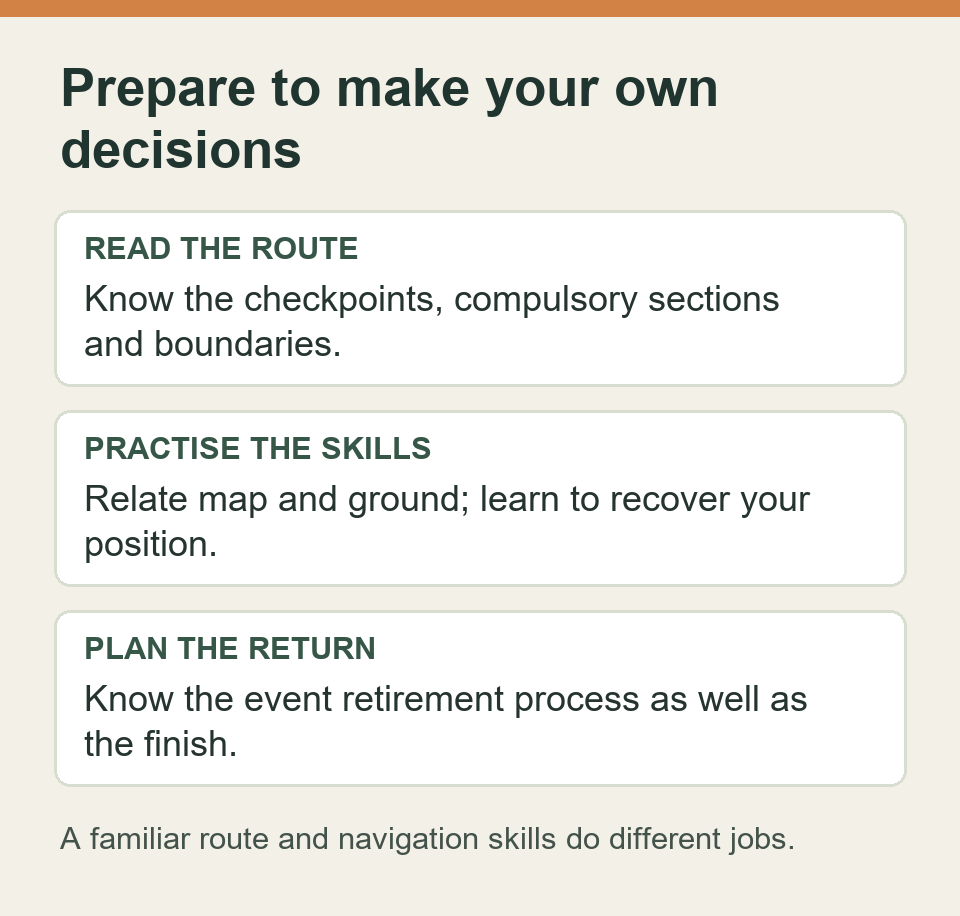
Recognising a familiar summit in clear weather is one task. Relating the map to the ground, identifying a decision point and recovering your position are skills you may need when it is less familiar. Practise them with suitable instruction and company before relying on them in a race.
Dan’s 2026 Lostock AC Silverhow report describes how much he valued a clubmate’s guidance and identifies navigation as a skill to improve. Use a group outing to learn how decisions are made, rather than merely staying close enough to follow the person in front.
Plan for the conditions you may meet
Check an appropriate Met Office mountain forecast as well as the organiser’s latest updates. Consider what the predicted visibility and conditions mean for the terrain you would cross. If your route knowledge depends on seeing a distant landmark, cloud changes the decision you have to make.
Ask yourself where you would notice that the expected feature had not appeared, and how you would work out your position. If the answer is “I would follow whoever is ahead”, that is a skill gap to address before choosing a self-navigation event.
A recce in one set of conditions cannot show every state of the course. Choose a race within your experience and accept a change of plan when the conditions exceed it. Check whether the organiser has issued an alternative course, additional requirements or a cancellation; those are race-specific decisions.
Check kit and the retirement procedure together
Table 2 of the FRA organiser requirements specifies minimum kit for AL, AM and BL races, with other standard categories following the organiser’s requirements. The minimum includes waterproof whole-body cover with taped seams and an attached hood, hat, gloves, physical map, traditional compass, whistle and emergency food. Read the document’s garment requirements and the event’s full list; extra kit may be required.
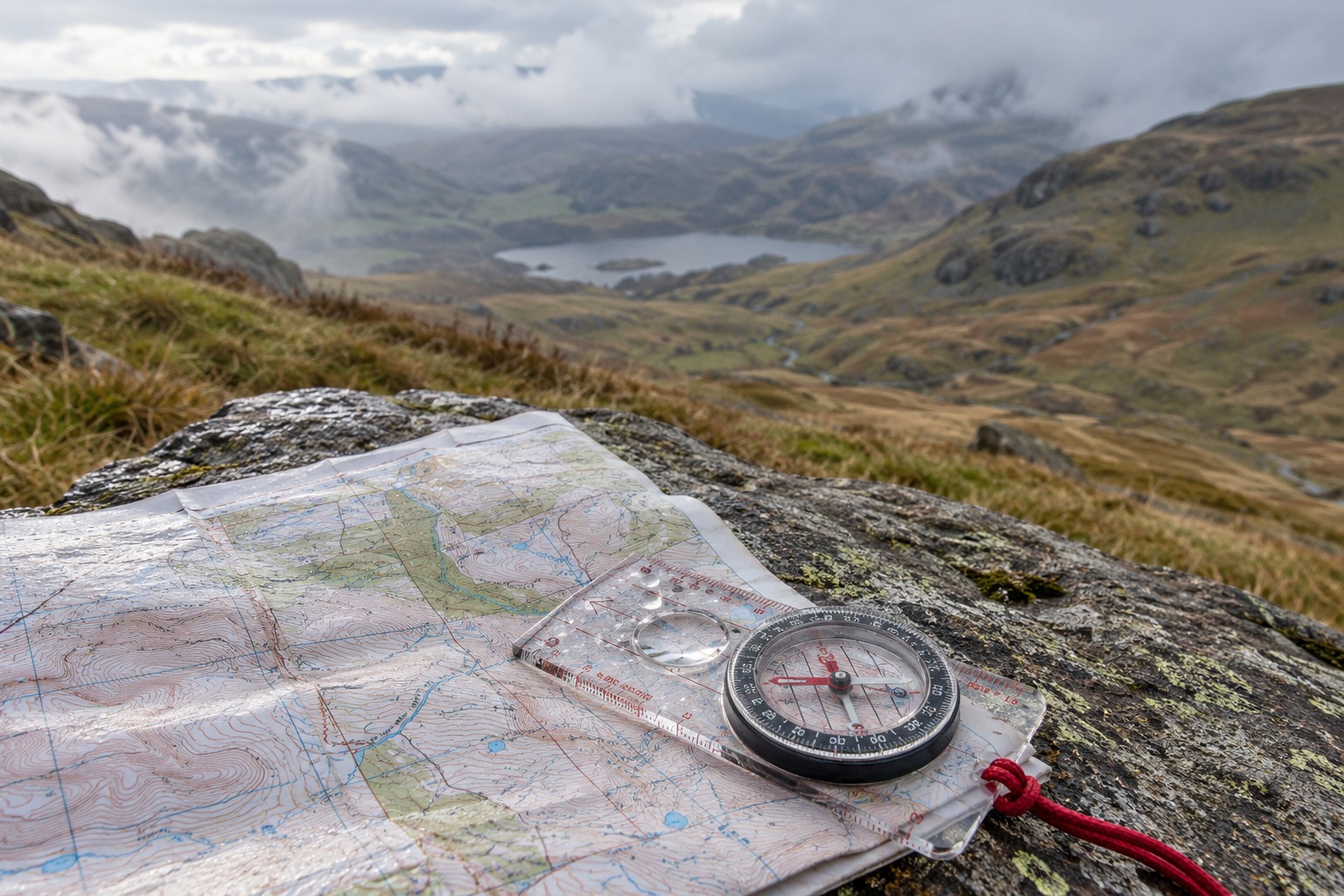
Make the map and compass accessible in the kit you will actually wear. Carrying them at the bottom of a bag is a different practical arrangement from being able to retrieve and use them when needed. Keep mandatory running kit with you rather than handing it over with finish-line clothes.
The FRA’s retirement guidance requires you to report to the organiser at the finish. Do not simply leave for your car because you have stopped racing. Find out the event’s exact reporting process before the start so that race control can account for you.
The race-day packing checklist helps separate what stays with you from what waits at the finish. Use the fell event’s instructions to decide the contents; an ordinary race checklist cannot supply its mandatory kit rules.
Resolve these questions before entering
Can I identify the required checkpoints, compulsory route sections and boundaries?
What is marked, and where will I have to choose a line myself?
Can I use map and compass to manage this terrain and recover my position?
Do I meet the organiser’s experience criteria and understand the cut-offs?
Have I checked the device restrictions, kit list and latest course information?
How do I return and report if I do not finish?
If you want to build skills first, a local fell-running club or structured navigation course gives you a way to do that before committing to a race. Use the first-fell-race comparison when you are ready to look at particular courses, and the category guide to decode their listings.