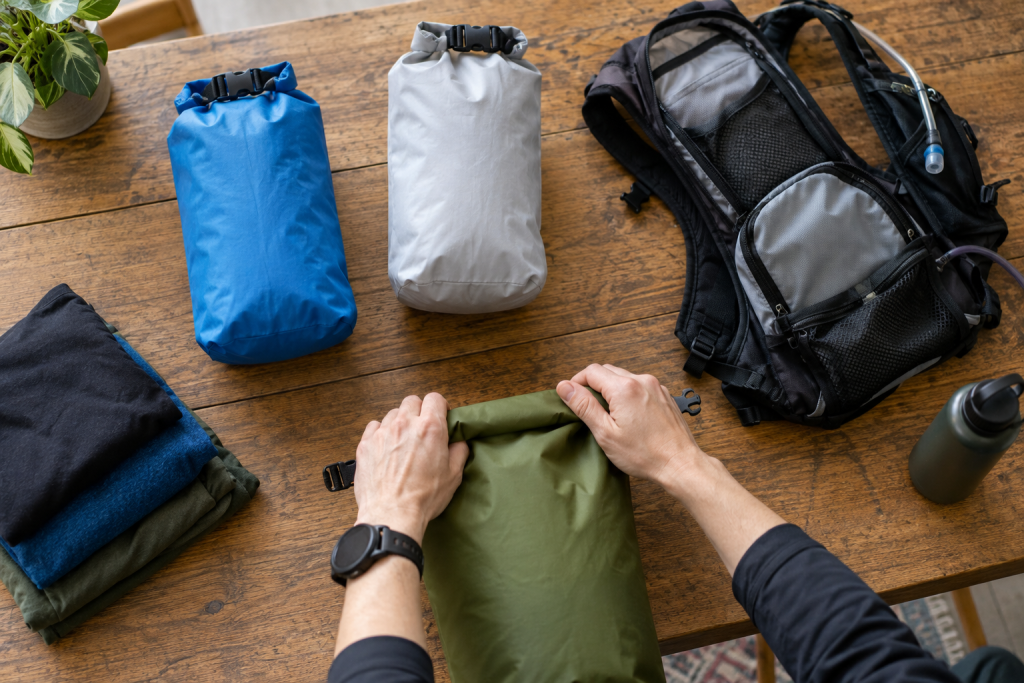
A dry bag can keep spare kit organised and add protection inside a running pack, but the name alone does not tell you what conditions it handles. Closure technique, seams and material matter. Electronics deserve particular care: a lightweight roll-top storage sack is not automatically a submersible phone case.
Start here → choose by use
Choose protection for the contents and likely exposure first, then check the bag fits inside your loaded pack. Separate dry clothing from electronics and from muddy kit rather than treating one oversized sack as a universal solution.
Compare the practical trade-offs
| Option or check | Useful when | Trade-off to check |
|---|---|---|
| Lightweight internal dry storage | Keeping spare clothing organised inside a pack | Check closure guidance; do not assume immersion protection |
| More robust external-use bag | The bag itself faces abrasion or exposed conditions | Weight and bulk may be unnecessary inside a vest |
| Rated electronics enclosure | You need a specific protection claim for a device | Check the exact rating, dimensions and permitted use |
Choose around the contents
Put the actual jacket, gloves or dry top together and estimate the space they occupy without crushing delicate items. Leave room for the closure to work as instructed; do not fill right to the opening. Several small bags can improve access, but they also add closures and complexity. Buy the smallest practical arrangement, not the smallest advertised capacity.
Understand the closure limit
Follow the maker’s instructions for the number and direction of rolls and the fastening. Sea to Summit distinguishes roll-top bags from intentional-submersion protection; its guidance warns that water can enter through a closure under those conditions. Treat this as a reason to check precise use limits, not a claim that any dry bag will keep a phone safe during an obstacle-race dunking.
Test without risking valuables
Inspect the seams and closure before use. If the manufacturer recommends a test, follow that procedure without putting a phone or other valuable device inside first. Do not conduct an improvised pressure or immersion test beyond the product’s intended use. A quick test today also does not remove the need to check wear later.
Keep the packing sequence clear
Make the weather layer and required equipment findable without emptying the whole vest. Store a wet or muddy item separately so that reopening one bag does not contaminate everything dry. After the run, clean and dry the bags as directed before folding them away. Damaged coating or a worn closure is worth investigating before the next event.
Your pre-purchase checklist
- Identify contents and expected exposure.
- Allow enough room for the correct closure.
- Check packed shape in the actual running compartment.
- Inspect, clean and dry after use.
When not to buy
A basic organiser bag may be enough for items that do not need moisture protection. Do not pay for a submersion claim you do not need, or assume a cheap storage sack provides one.
A shopping starting point
The button below opens an Amazon UK search. Search results can include adverts, unrelated accessories and different variants. Use the checklist above to assess an exact product, then confirm its manufacturer instructions, selected size, supplied items, seller and return conditions.
Browse relevant options on Amazon UK
Questions runners ask
Can a dry bag protect my phone during OCR?
Only where the precise enclosure and use conditions support that claim. An ordinary roll-top bag is not a universal submersion solution.
Should every item have its own bag?
Not necessarily. Group compatible contents while keeping quick-access and wet items separate.
Build the rest of your kit
Read How we produce our guides.
Manufacturer references: Sea to Summit: Packing Electronics.