The field guide · Lap racing
Backyard ultra, timed laps or a 24-hour relay: which format suits you?
By James Thompson · Updated 2 November 2026
Some links in my articles are affiliate links. I may earn a commission when you buy through them.

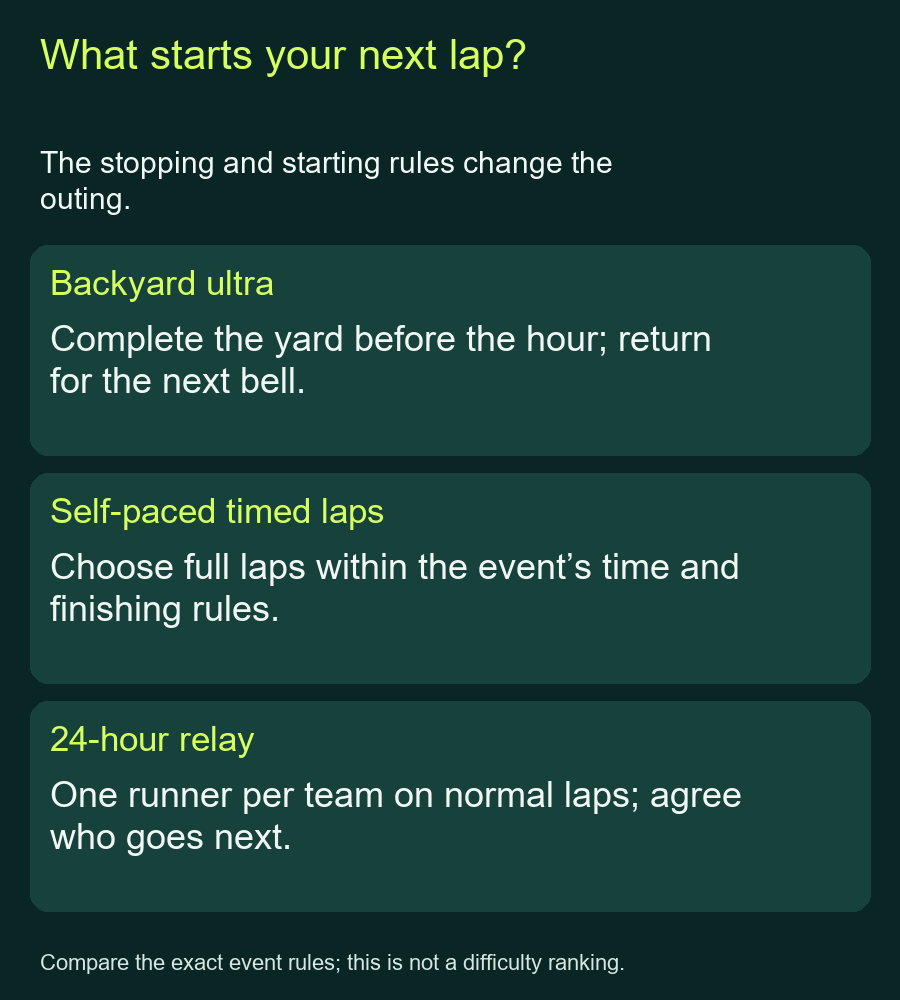
Choose a self-paced timed event if you want to decide how many laps to run within a fixed time limit. A backyard ultra suits a different challenge: returning for another start every hour. A 24-hour relay lets you share the running with friends, but your own outing will depend on team size and the rota you agree.
The repeated route is only part of the choice. The rule that applies when you stop, arrive late or hand over can change the day more than another kilometre of trail. The examples below use current organiser information checked on 2 November 2026, including Phoenix’s December 2026 Christmas Gonk and Endure24 Reading 2027.
Table of Contents
ToggleCompare what happens at the end of a lap
| Format | What the next lap asks of you | Useful reason to choose it |
|---|---|---|
| Open-ended backyard ultra | Finish the yard in less than an hour, then start again at the next bell. | You want the repeated hourly commitment and can accept not knowing the eventual race length. |
| Self-paced timed laps | Choose how many full laps to complete under that event’s time and finishing rules. | You want a personal distance goal with opportunities to stop at base. |
| 24-hour solo or relay | Accumulate laps over the event period; a relay allows a teammate to take the next turn. | You want a long event based around camp, either on your own or sharing the course time. |
These are format differences, not difficulty grades. Check the exact event name and edition: a race called Backyard 6 or Backyard 24 has a defined finish, while the standard open-ended backyard ultra does not.
Backyard: every hour brings another start
The Big’s Backyard rules specify a yard of 6.7056km. Each must be completed in less than an hour, with runners in the starting corral for the next bell. A late start ends your participation even if you think you could catch up on the course.
A 50-minute yard leaves ten minutes before the next start; a 55-minute yard leaves five. That remaining time must cover whatever you need at base. Neither calculation is a recommended pace: choosing an effort you can repeat is different from running faster simply to create a longer stop.
In the open-ended format, the winner must complete one more yard than everyone else. If nobody manages that extra yard, there is no winner. All other results are technically DNF, with completed yards still recorded. Decide whether you would be content with your own distance under that result convention. The same rule page recognises bounded Backyard 6/24-style events, where runners finish or DNF and no winner is named.
Support also changes on the course. The standard rules prohibit personal aid during a yard, non-competitor pacers and artificial aids including poles. Having someone at base does not mean they can accompany you around the loop.
Timed laps: choose an event that lets your distance grow
The Cambridgeshire Christmas Gonk on 27 December 2026 is a useful concrete example. Phoenix describes a 5.3km out-and-back at Grafham Water, a six-hour limit and a finisher’s result after one completed lap. You can decide after a lap whether to continue, rather than committing to a marathon before starting.
Its page describes mainly tarmac cycle paths with a small gravel section and little elevation change. That is a different ground profile from an undulating woodland relay. It is not evidence that every Phoenix event uses the same surface or lap length.
The advertised start window is 08:00–09:00. Before relying on the whole six hours, establish how your start affects the closing time and when another lap may be refused. The event page does not settle those details here. Also check Phoenix’s current terms for age and distance restrictions before choosing an ultra-distance target.
If you mainly want to try running beyond your usual distance, this sort of format gives you a place to reassess at each return. Agree with yourself what would make it a worthwhile outing before the first lap, including a shorter finish if the day develops differently.
A 24-hour relay is not 24 hours of running each
At Endure24 Reading 2027, the published course is an undulating 8km trail lap at Wasing Park. The event offers solo, pair and team entries. As a solo, the time spent resting comes out of your own event clock; in a relay, a teammate can continue while you are off the course.
The organiser’s format guide permits one runner from a pair or team on normal relay laps at a time, multiple consecutive laps and breaks for the whole group. This is a relay with a shared base, rather than a group run where everyone completes the trail together.
Choose the role before estimating your personal distance. A pair can create frequent returns to running with comparatively short gaps; a larger team can leave longer intervals between turns. The Endure24 laps and rota guide works through the arithmetic and why time off course is not all usable rest.
Look beyond the lap length
Separate the hours you want to spend out, the climbing and footing, the navigation task and the support you can use. A short loop repeated many times can build a substantial distance. Its familiar junctions do not flatten an uphill or make wet ground easier to run.
Endure24’s signage guidance describes a marked route. That reduces one planning task compared with a navigation event, but you still need to see the ground and signs at night. A backyard’s prescribed length, by itself, tells you nothing about that particular venue’s climbs or surfaces.
Check the rule that would make you stop
Before entering, write down the exact race, entry category and what counts towards its result. Check whether you can pause and restart, the last permitted lap start, the final-lap completion limit and how to report retirement. Do not transfer a finish rule from another organiser just because both races use loops.
For Endure24, the current overview is useful for choosing a role, but confirm the exact edition’s final-lap and participation requirements in its current instructions. For a flexible-start event, establish whether the relevant limit is your elapsed time or a fixed clock time. The race cut-off calculation guide explains that distinction.
Choose the event whose stopping and support rules fit the outing you want. If you want to finish after a few satisfying laps, check that the format recognises that finish before choosing the appeal of an hourly bell or an all-night camp.