Some links in my articles are affiliate links. I may earn a commission when you buy through them.
Before entering a night trail race, find out whether its cut-off is a duration to the finish or a clock time at a checkpoint. Convert it into elapsed time from your own start, then include walking, stops and a realistic margin in your plan. A watch’s moving pace can hide the time that counts against the deadline.
The examples here use official 2026 instructions checked on 28 October. They explain the calculation; they do not predict your finish or carry the rules forward to another edition. The Illuminator’s 24 October event is now past.
Write down the place you must reach, the deadline and when your allowance begins. Ask whether a finish cut-off runs from the scheduled start, the gun or your timing-chip crossing. For a checkpoint, establish whether you must arrive or leave by the stated time. If the event page does not settle those questions, resolve them before relying on a narrow margin.
Keep finish and intermediate limits on separate lines. Reaching an early checkpoint before its closure does not establish that you can finish in time, and a generous finish allowance does not cancel an earlier checkpoint deadline.
Compare BigNightOut’s two finish allowances
The 7 November 2026 BigNightOut page lists three hours for 12km and three and a half hours for 22km. Dividing the whole allowance by the published distance gives an elapsed average, including any stops:
Listed course
Published cut-off
Whole-allowance average
12km
3 hours / 180 minutes
15:00 per km
22km
3½ hours / 210 minutes
About 9:33 per km
The longer race allows only another thirty minutes for an extra ten listed kilometres. It therefore asks for a substantially quicker overall average as well as more distance. Neither figure tells you how fast to run each hill or descent.
Use these as arithmetic comparisons, not target moving paces. The shorter course is labelled 12km in the entry and cut-off sections but 11km in the route description. Confirm the final distance before using a precise pace calculation.
A clock-time checkpoint gives different routes different windows
The Illuminator’s 2026 FAQ says all runners must reach checkpoint 8 near the Light Zone by 22:00. The three route pages publish different starts, so the available time to that checkpoint differs:
2026 route
Published start
Time until 22:00 checkpoint
8km
19:00
3 hours
15km
18:45
3 hours 15 minutes
15 miles
18:30
3 hours 30 minutes
Starts are from the organiser’s 8km, 15km and 15-mile pages. These are checkpoint windows, not finish allowances. The routes converge at the Light Zone, and there is still course left afterwards.
The FAQ’s approximate remaining distance is given as both 2.5 miles and 4.5km, which are not equivalent. Do not use that pair to derive an exact checkpoint position or required pace. Get the current checkpoint distances and final instructions; then check the remaining climbing and finish arrangements too.
Reserve time for what happens while you are stopped
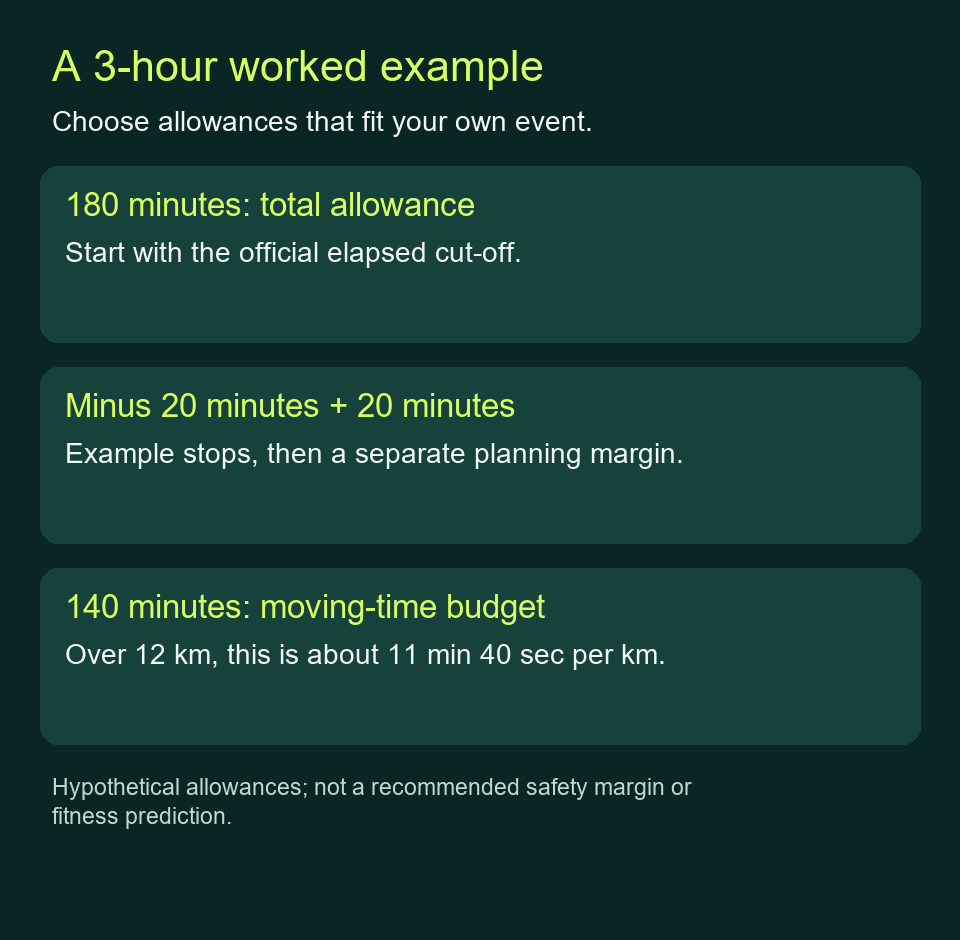
Suppose an event allows three hours over a confirmed 12km. For a worked example, set aside twenty minutes for stops and another twenty minutes as a planning margin. That leaves 140 minutes of moving time: 140 ÷ 12 = about 11 minutes 40 seconds per kilometre.
Those twenty-minute allowances are hypothetical. Choose yours from the event, conditions, your experience and the ways off the course. The calculation does not establish that a particular margin is adequate. A drink stop, clothing change, queue or wrong turn all uses elapsed time even when the watch pauses itself.
Example allowances, not organiser rules or a recommended safety margin.
Check the watch screen you use during a practice outing: elapsed time and moving time answer different questions. Keep the official clock or start convention alongside your own timings so you can compare them without mental adjustments at every stop.
Budget the difficult sections separately
Use a recent outing on comparable ground to estimate sections, including walking the climbs you expect to walk. Add their times, your stops and the remaining route beyond each checkpoint. A road-race average stretched over a steep night course gives you little information about where time will go.
For example, if the first half of a route contains most of the climbing, expecting to reach halfway in half your total moving time may be unrealistic. Conversely, reaching halfway quickly does not create a reliable buffer if the main climb is still ahead. Use the actual profile and checkpoint locations rather than dividing the distance evenly.
When a limit looks tight, choose a shorter or more suitable format, or build more relevant experience before entering. Do not make the plan depend on running ground you would normally walk or rushing a descent. If you retire during an event, follow its reporting procedure so the organiser can account for you.
Keep the race clock and the lighting plan separate
A checkpoint deadline does not say when you will finish needing light. Include the remaining course and return to transport when using the headtorch runtime guide. Follow the event’s required light and backup arrangement rather than assuming the short distance needs less kit.
Use the night-event comparison to choose between railway, downland and hill formats before committing to a time target. Once the final instructions arrive, put the required kit into the Race Day Pack Planner and keep a separate note of the start convention, checkpoint deadlines and retirement contact.