Some links in my articles are affiliate links. I may earn a commission when you buy through them.
At Endure24, choose your role by the distance you want to take on and how often you are prepared to return to the course. A pair may mean substantial running with only a short gap between turns. A larger team usually creates longer gaps, but getting changed, eating and reaching the exchange all use part of them.
This guide uses the published 8km lap for Reading 2027 at Wasing Park and the organiser’s current format guidance, checked on 2 November 2026. The rota examples are calculations with stated assumptions, not predictions of your result, sleep or the final course conditions.
The Reading 2027 event page lists the weekend as 4–6 June, with a 24-hour race and solo, pair or team options up to twelve runners. Use the event instructions to plan the race start and camping arrangements within that weekend; the dates do not mean three days of continuous racing.
For a solo, every completed lap is yours, and you decide when to take a break. A pair shares the running between two people. A team can keep sending someone out while the others are at camp, or deliberately pause. Choose whether your priority is continuous team laps, everyone’s personal target or a sociable weekend before drawing up the order.
The current format guide groups teams as small (3–5), large (6–8) and XL Fun (9–12). It also gives different age requirements for solo, pair and team roles, so check your intended category rather than treating every entry as interchangeable. Endure Relays is a separate event series; use the Endure24 instructions for this plan.
Start with a simple 24-lap example
Suppose a relay completes 24 full 8km laps, each taking exactly 60 minutes, with immediate exchanges, a fixed order and equal shares. That is 192km for the team. Dividing it by the number of runners gives the following model:
Runners
Laps each
Distance each
Gross gap after your lap
2
12
96km
60 minutes
4
6
48km
180 minutes
6
4
32km
300 minutes
The gap is the time taken by everyone else’s laps before your next turn. It starts when you finish and ends when you start again. For a solo there is no equivalent teammate-created gap; any break is time when you are not accumulating laps.
These rows divide a hypothetical total; they do not promise that your team will complete 24 laps, or establish which final lap the organiser will count. Check the current last-lap rules before turning any rota into a finish-time plan.
Different lap times give different gaps
Equal turns do not necessarily give equal time off course. Imagine four runners taking 50, 60, 70 and 80 minutes in that order. One complete rotation takes 260 minutes, or 4 hours 20 minutes.
The 50-minute runner then has 210 minutes off course while the other three run. The 80-minute runner has 180 minutes while the other three take their turns. Everyone starts once per rotation, yet the time available after finishing differs by half an hour.
Build the first rota from each person’s plausible trail-lap time and revisit it during the event. Include slower night laps and stops in the estimate you use for the next handover. If one runner takes longer than expected, update the next runners rather than keeping everyone tied to an obsolete arrival time.
Use doubles deliberately
The organiser allows consecutive laps by the same runner. In the simple one-hour model, doing two laps gives your partner two hours off course instead of one. It also commits you to 16km before returning for your own break.
Discuss that trade-off before using doubles to create a longer overnight rest. A plan that suits one person may leave the other with more running than they intended. Agree the return turn as well as the first double, and revise both if conditions or lap times change.
Only one member of the pair or team should be running a normal relay lap at a time. The organiser describes a separate arrangement for teammates to join a final finish; it does not make ordinary laps a group run.
Turn time off course into usable rest
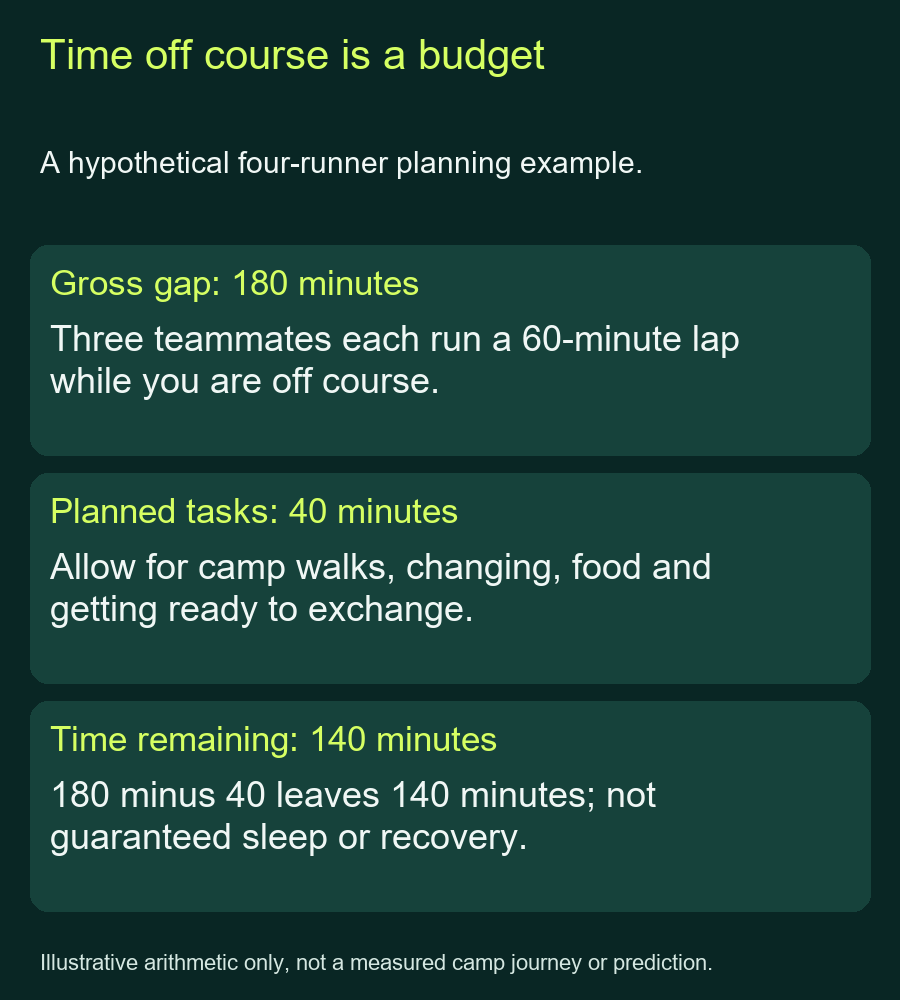
A three-hour gap gives 180 minutes away from the course. If your planned walk to camp, clothing change, food and return to the exchange use 40 minutes in total, 140 minutes remain. That is an illustrative task budget, not a measured camp journey or a guarantee of sleep.
Hypothetical task budget: 180 minutes minus 40 minutes leaves 140; no sleep or recovery guarantee.
Map the exchange and your actual camping place when you arrive. Keep the things you need between laps together, and agree how the next runner will be woken or called. Leave them enough time to be ready before the expected return, including any walk from camp.
The current night-visibility FAQ requires a headtorch during the specified night period. Recheck the 2027 instructions for the exact lighting and backup requirements. The headtorch runtime guide helps you budget useful light across your own night laps and time around camp.
Agree the handover before the first lap
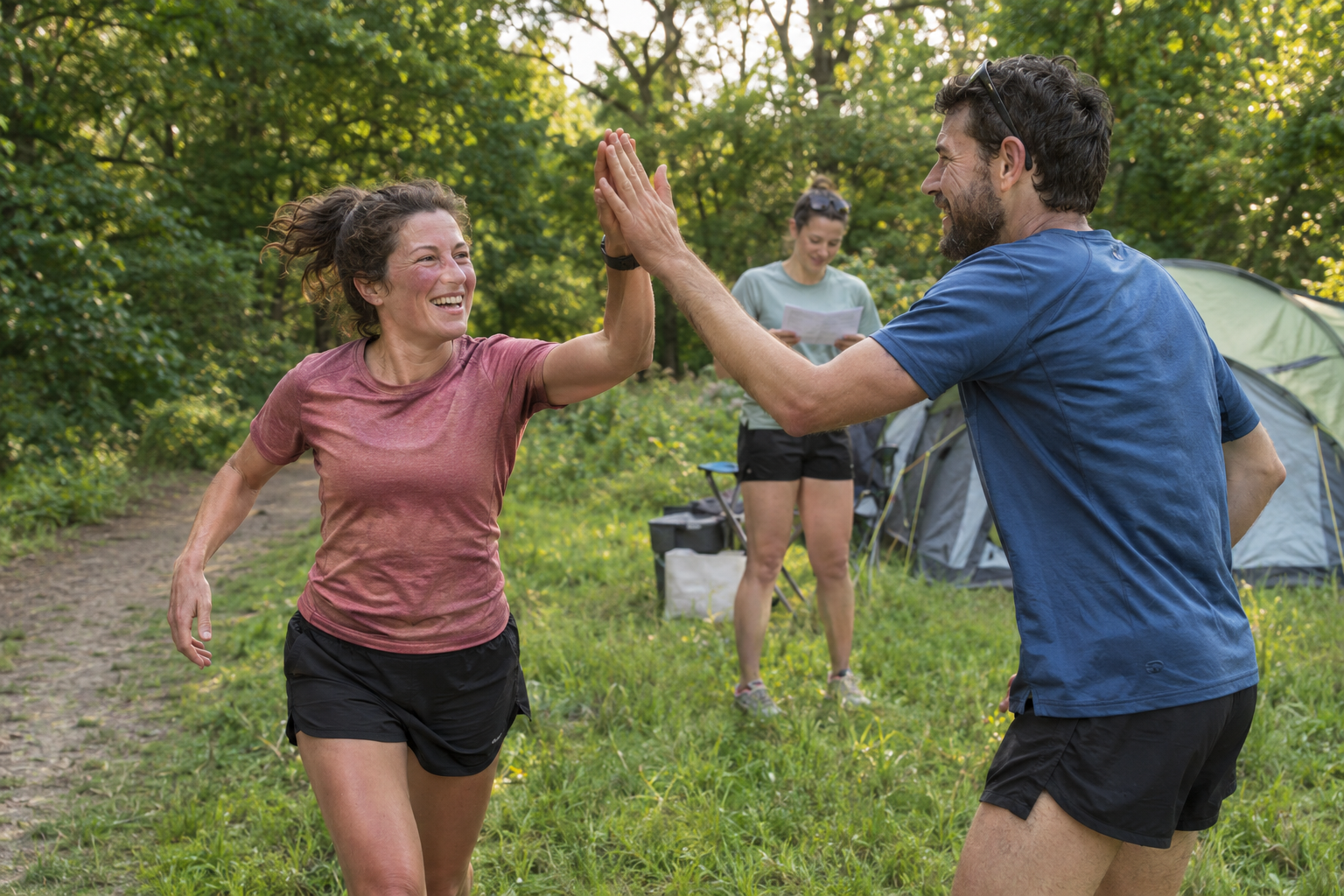
The organiser describes contact with the next runner in the exchange area, such as a high-five. If that runner is absent, you can wait or carry on for another lap. Agree which response your group wants, so an unexpected double does not happen simply because nobody knows who is next.
Keep one current order showing the next runner and who will alert them.
Record completed laps and update the expected arrival after a change of plan.
Agree what happens if someone needs a shorter share or the whole team takes a break.
Read the current retirement procedure, minimum participation and final-lap rules before relying on a target total.
The timing FAQ says the chip records completed laps. Keep your rota as the plan for people and handovers, rather than treating it as the official result. Choose the team size that leaves everyone comfortable with their likely share and the time they will spend waiting to run again.