Some links in my articles are affiliate links. I may earn a commission when you buy through them.
In a standard FRA fell-race listing, the first letter describes the ascent category and the second the distance category. AS means A-short; BM means B-medium; AL means A-long. Read the two letters separately before trying to judge whether the race suits you.
They describe only part of the course. A code does not tell you how rough the descent is, whether cloud will hide the next checkpoint or whether you have the experience the organiser requires. Use it to narrow your research, then read the route and entry conditions.
These definitions come from Table 1 of the FRA’s 2026 Requirements for Race Organisers, checked on 26 October 2026. They apply to standard FRA fell races; relays and navigation formats have additional arrangements.
“Short” is a distance class. It does not promise a gentle first race. Before transferring a road-running expectation to the fells, look for the advertised climb and the nature of the return downhill.
Then read A, B or C
Ascent category
Minimum average climb
Maximum road proportion
A
50m of climb per kilometre
20%
B
25m of climb per kilometre
30%
C
20m of climb per kilometre
40%
The same official category table supplies these criteria and requires genuine fell terrain. Category A races must also be at least 1.5km long. These are minimum ascent figures, not three non-overlapping bands into which every GPS reading can be sorted. Keep the organiser’s published category rather than trying to relabel a race from one calculation.
Average climb means the total ascent divided by the whole course distance. On an up-and-down race, that distance includes the descent and any flatter approach. It therefore says little about how steep the main uphill section becomes.
Work through three real sets of figures
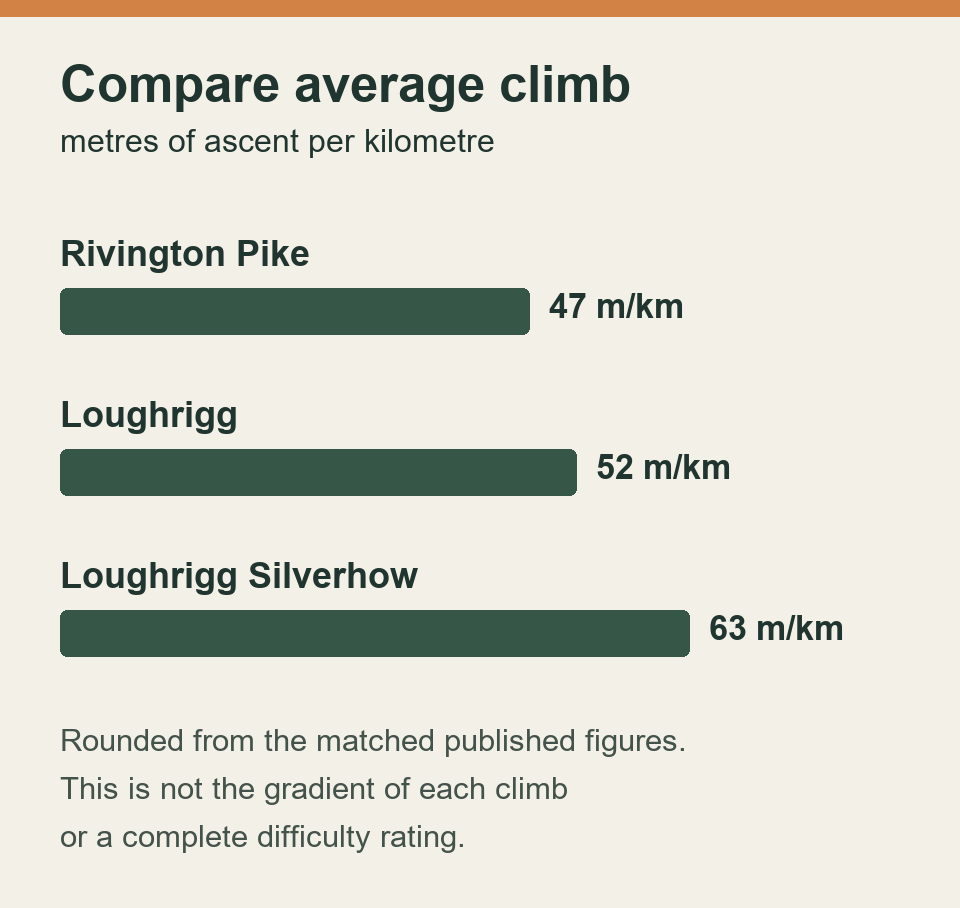
Calculated from the matched published figures below, rounded to the nearest metre per kilometre.
This explains why the letter alone is a coarse comparison. A B-short example and an A-short example can sit fairly close together in average ascent, while their surfaces and downhill sections still feel different. Rounded source figures should not be used to argue about a course being a few metres either side of a classification threshold.
Nor does 52m/km mean that the hill maintains a 5.2% slope. The calculation spreads all the climbing over the whole course, including sections that go downhill. For the climb itself you need the route profile and terrain description.
What the code leaves out
Two races with the same code can ask for different skills. A long runnable track, a rocky descent and a route across indistinct grassy tops do not become equivalent because their headline ascent and distance match.
Ground: look for rocks, mud, grass, narrow paths and steep sections in the actual course description.
Distribution of effort: a single climb and return differs from several climbs spread through a loop.
Navigation: check the checkpoints, permitted lines and marking information.
Conditions and timing: inspect the season, start time and mountain forecast.
Entry requirements: read the experience criteria, cut-offs and required kit.
For example, Ambleside describes an evening timing concern for the short Loughrigg race, while its Silverhow event includes a first-checkpoint cut-off and route choices. Neither detail can be recovered from AS or AM alone. Our three-course comparison puts those details back alongside the numbers.
Take ER, NS and LK seriously
The FRA FAQ explains ER as experience required, NS as navigational skills required and LK as local knowledge an advantage. Those flags describe preparation and eligibility, rather than another distance scale.
Silverhow’s 2026 listing includes all three. If you read “14km” and think only of the distance you ran last weekend, you miss information the organiser has deliberately supplied about the kind of experience needed.
Look for the required experience on the event page and check how you must demonstrate it. If the wording is unclear, resolve it with the organiser before entering. Do not treat a missing NS flag as an assurance of a fully marked course; the navigation guide covers that distinction.
Read a listing in this order
Confirm the exact event, edition and participation category.
Read the distance and ascent as a pair, keeping the source units together.
Use the category code to understand the broad course class.
Read the terrain, checkpoints, markings, cut-offs and experience criteria.
Check the current kit requirements and any course changes before entry and again before race day.