Some links in my articles are affiliate links. I may earn a commission when you buy through them.
For a two-day mountain marathon, plan the overnight camp as part of the course. You arrive carrying the things you need to shelter, eat and sleep, then take them out again on Sunday. Choose the event and your partner with that whole sequence in mind, rather than judging the weekend by the running distance alone.
Saunders’ current guidance, checked on 3 November 2026 ahead of its advertised July 2027 event, is the main example here. The completed OMM 2026 event provides a useful comparison where support differs. Final event instructions govern the actual camp, water, equipment and retirement arrangements.
The Saunders FAQs say competitors carry their food: there is none provided at the overnight camp, and friends, family, shops or pubs cannot supply extra food during the event. Preordered camp drinks are a separate arrangement.
Make a simple food inventory for the journey from Saturday’s start through Sunday’s finish. Include what you intend to eat while moving, the evening meal and breakfast, with the emergency reserve identified separately. Check it against the organiser’s current requirements before dividing it between packs.
Saunders provides water at the event centre and camp, but notices may require it to be boiled. It does not provide course feed or water stations. Confirm the water instructions and the capacity you need for the next stage; do not assume arriving at a water supply means you can immediately fill a bottle and set off.
Its GPS FAQ also says there are no camp charging facilities. Check the intended jobs for each device before leaving home and conserve power for the permitted uses. A safety tracker does not grant permission to navigate with a phone or watch.
Split the jobs as well as the carried kit
The Saunders equipment rules distinguish individual items from team equipment. Each person needs their own insulated sleeping bag or permitted sleep system and a survival bag; a space blanket is not the listed substitute. The team carries a shelter large enough for both people and cooking equipment. Read the full list for the exact specifications and reserves.
Make two lists before packing: what must remain with each person, and what can be allocated as shared equipment. Next to each shared item, write who carries it and who checks that its essential parts are present. Include the required poles and pegs with the tent allocation.
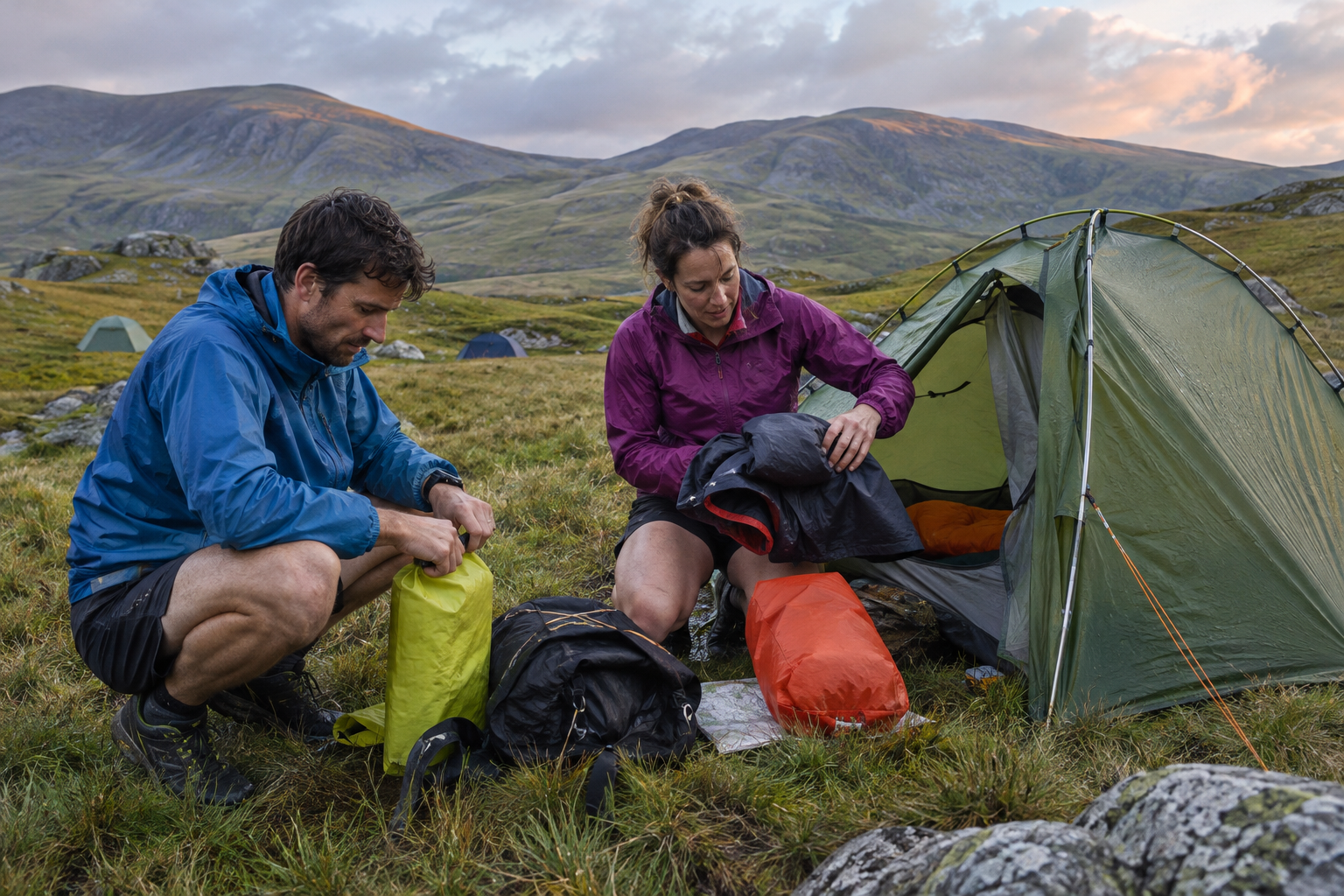
Agree the camp jobs too. One person can start organising the shelter while the other sorts the water plan and locates dry clothing and food. Both should understand the equipment and be able to find it in either pack. Balance the load around the pair’s abilities instead of making the faster runner responsible for every task.
Try the complete arrangement before the event. Pitch the shelter, get the sleeping kit out and pack it away again. You want to discover an awkward closure or missing part somewhere you can fix it easily.
Arrive, get sheltered and organise the dry kit
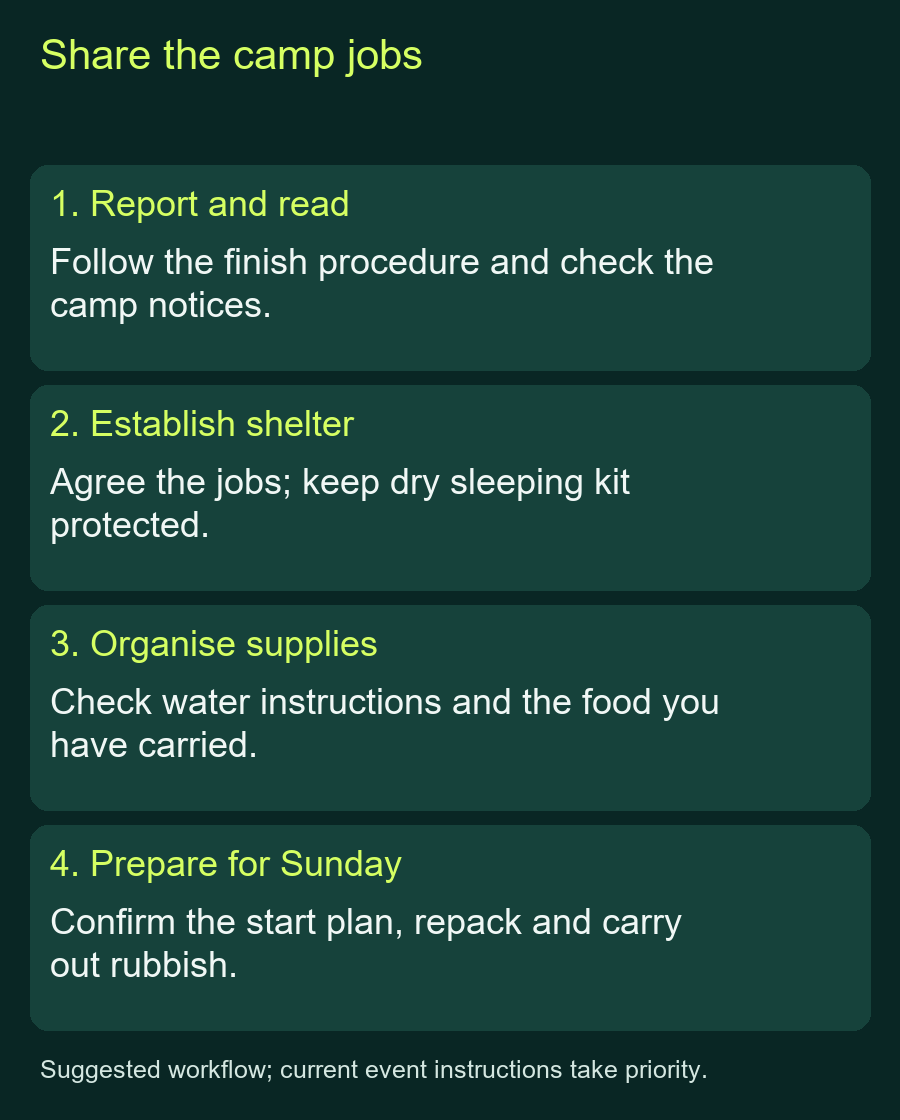
Follow the event’s finish and reporting procedure before settling into camp. Read the notices for water, toilets, the next start and any course changes. Decide together where the shared equipment will go, so bags and loose clothing do not become a search problem as the light fades.
A suggested division of tasks; follow the organiser’s actual arrival and safety instructions.
Keep the sleeping kit and spare clothing protected while handling damp outer layers. Put items needed immediately at camp where you can reach them without unpacking everything onto wet grass. The dry-kit organisation guide explains how to separate frequently opened items from clothing you want to leave protected.
Give damp and dry items distinct places inside the shelter and packs. Leave room for the less tidy load that comes after a night out: wet fabric and opened food rarely repack like the carefully folded kit you started with.
Leave a workable Sunday morning
Before settling down, check the next day’s start arrangements and decide when you need to begin packing. Work backwards through breakfast, water preparation, taking down the shelter and getting the full load back into the packs. Allow for both people’s tasks; there is little benefit in one runner being ready while the shared tent is still spread over the grass.
Make the things you will need early easy to find. Keep permitted timekeeping available, identify the remaining food and agree who will check the pitch before leaving. Carry out rubbish as instructed; Saunders does not allow it to be left at the overnight camp.
Your route choice on Saturday should leave you able to manage these jobs and return to the hills. Reassess the plan together if one person is struggling. Saving enough energy to deal with the night and Sunday is a useful reason to choose a more modest first course, even when you could manage a longer single day.
Agree how to shorten or withdraw
Saunders currently allows line-course teams to request a shorter Sunday course at camp, including an extra-short option. You can receive a day result, but switching means losing a place in the overall results. That is a different decision from retiring completely; ask officials which arrangements apply to your situation.
Its current retirement FAQ asks you to tell the download team and return the timing device and tracker. It describes a Sunday-morning minibus for people unable to make their own way back. Tell officials before leaving under your own arrangements.
By contrast, the OMM’s displayed 2026 race instructions required ordinary overnight retirees to arrange their own return, with transport provided only for serious injury. Do not transfer the Saunders minibus arrangement to another event, or expect a race camp to work like a campsite beside your car.
Before entering, establish what the organiser expects if your pair cannot continue from camp. Once there, follow the current reporting and return instructions rather than leaving without telling anyone.