Some links in my articles are affiliate links. I may earn a commission when you buy through them.
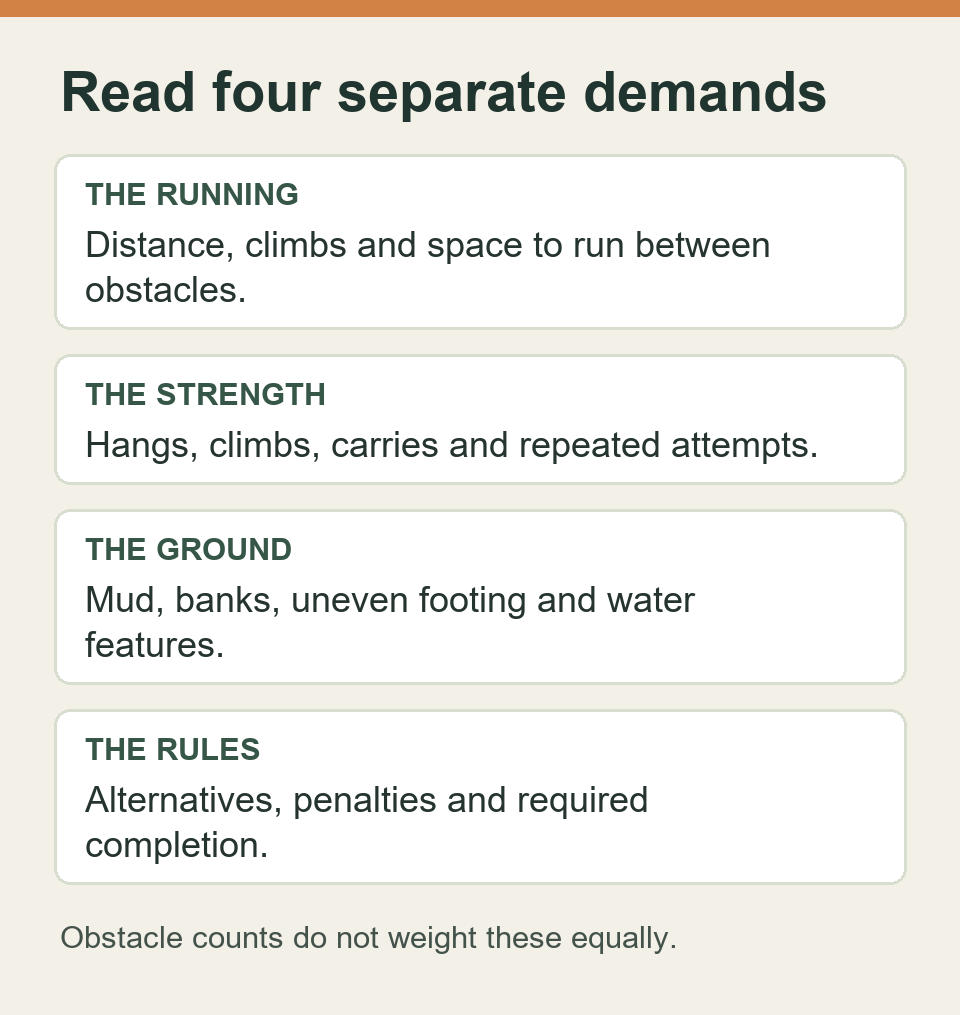
An obstacle race can challenge a regular runner in a place their usual routes barely touch: hanging from their hands, carrying a load uphill or getting out of a muddy bank. To judge a course, separate four demands: the running, the strength work, the ground and what the rules require when an obstacle defeats you.
A shorter course can introduce a harder skill. A longer course may simply extend a type of effort you already enjoy. Neither distance nor obstacle count can tell you which will feel harder to you.
Look for a route map and elevation information for the exact edition. A long stretch of runnable track offers a different task from repeated climbs, bank scrambles and narrow woodland sections. When an organiser publishes no elevation figure, keep it as unknown rather than substituting a description such as “undulating”.
Participant reports can reveal where the effort sits. In an organiser-hosted 2026 London West report, Reece Statham-quilty describes flowing trails and hills early on, followed by more concentrated grip work. That is one competitive course, but it gives you a better question to ask than “How many kilometres?”: what arrives after you have already done the running?
Watch footage of the ground as well as the spectacular structures. Can you see sustained running, repeated stop-start movement or people negotiating banks? Check that the footage is from the same venue and distance, and remember that a highlight reel leaves things out.
Separate hanging, climbing and carrying
A hang asks you to support your body while your hands hold the obstacle. A wall asks you to get over a barrier; the allowed technique or help can change the task. A carry puts a load into the running or walking section. Counting each as “one obstacle” gives them an equal weight they do not deserve.
Make a separate note for each demand when comparing two courses.
Conor Capplis’s 2023 London West Sprint account is instructive for runners: he describes failing angled monkey bars because he lacked grip and energy. Sara’s 2025 Total Warrior account describes an uphill log carry. Those are different reasons for a running pace to disappear.
On a course list, mark the hangs, climbs and carries separately. Then look for information about their order and the rules for assistance. If the carrying load is not published, leave it as unknown; a photograph will not give you a reliable weight. If improving a particular skill is the attraction, choose a course that actually includes it.
Treat mud and water as course features
Ground can be a challenge in its own right. Wolf’s obstacle descriptions distinguish a muddy bank section at Entrenched, fallen timber at Deadwood in Leicestershire and a steep wooded climb at North Face in Warwickshire. Those require different movement from a clear path, even before considering the walls and bars.
Andrew Foster’s 2024 Wolf Run account describes relying on friends on steep muddy banks. Holly Worthington’s 2016 Nuclear Rush report records slippery ground alongside hanging obstacles. These observations explain why a route can feel demanding without establishing a permanent difficulty rating for either event.
For water, identify the feature: wading, a swim, a jump, a slide or a submerged passage. They should not be collapsed into a single “wet” label. If one is unacceptable to you, resolve the course alternatives and bypass rules before using the distance as your deciding factor.
Compare course examples without inventing a ranking
Published example
What it helps you assess
What remains unknown
Wolf Run main 10K
Natural ground plus built obstacles; the published list labels venue differences.
How muddy the ground will be on your date, and the final layout.
Nuclear Rush ordinary 12K
The current organiser page advertises 70-plus obstacles through a mixed landscape.
A comparable difficulty weight for each counted obstacle.
Total Warrior, Bramham Park, Sara’s 2025 report
A participant describes hills, a log carry and mud alongside constructed features.
Whether the next edition repeats the same course or conditions.
Spartan London West Sprint, Capplis’s 2023 report
A short-format example where grip was still a limiting demand.
The next venue’s exact obstacles, terrain and applicable penalties.
The current Wolf main-event page and Nuclear Rush page establish those advertised formats; the linked participant reports above establish the historical observations. These examples are close enough to show why distance alone is unhelpful, but they are not a controlled comparison.
A useful private comparison might read: “Course A has a longer run; Course B has the hanging feature I want to try; both need a water-policy check.” You can make a choice from that without pretending to know which is universally harder.
Read the consequences of an unsuccessful obstacle
Completion rules affect how much work remains when a skill fails. Spartan’s April 2026 rulebook, section 3.17 distinguishes mandatory completion from pass/fail obstacles. Designated penalties can be a loop or burpees, depending on the event, course and category or heat. Do not plan around the old blanket advice that every failure means 30 burpees.
Ordinary Tough Mudder allows a bypass without a penalty. That may let a participant continue after deciding against a feature. It does not tell you how much running, mud or climbing remains on the rest of the course. A bypass-friendly event can still be a substantial outing.
Decide which result you want to compare afterwards: your time, the distance covered, the obstacles completed or the shared experience. Two runners can finish the same nominal course having chosen different permitted alternatives.
Choose the challenge you want next
If distance is already familiar, you might prefer to keep it modest while trying a new obstacle skill. If hanging is your favourite part, a longer running section may be the change you want.
Write down the distance and any published ascent for the exact course.
List the hangs, climbs and carries you would be expected to tackle.
Identify the ground and water features between them.
Read the attempt, assistance and penalty rules for your format.
Name the part you are looking forward to and the detail you still need answered.