Some links in my articles are affiliate links. I may earn a commission when you buy through them.
Going to an obstacle event alone and running every obstacle without help are different choices. A solo entrant can join a social challenge, while friends can attend the same event in formats that expect individual performance. Decide how you want to take part before choosing a team name or booking a wave.
For a mixed group, agree three things first: whether you will stay together, how you will handle unwanted obstacles, and whether anyone wants a competitive result.
Tough Mudder explicitly allows individual entries and says some obstacles require teamwork. That is useful if you want to attend without organising a group. It is still worth choosing whether you are comfortable asking nearby participants to work together, or would prefer a format in which you focus on your own effort.
Sophie Mei Lan’s 2019 Broughton Hall account describes her existing group joining others and receiving help from strangers. That shows how interaction can happen on a course; it does not guarantee that another entrant will run the whole route alongside you.
Plan the practical parts of a solo day too: arriving, keeping your belongings, getting changed and travelling home. Read the actual event information rather than assuming another participant will be available to hold things or help with transport.
Spartan’s Open and competitive heat descriptions give you a different participation choice. A friend who wants a competitive effort may need a different heat and a different course plan from someone wanting a relaxed shared outing. Talk about that before entries are linked.
A timing chip does not force a group to race one another. Nuclear Rush’s ordinary course information combines timing with optional obstacle completion. You can use a result as a record of the day while agreeing to move around together.
If your priorities diverge, attending the same event and meeting at the finish may work better than asking one person to abandon their goal halfway round.
What teamwork means on the course
Tough Mudder’s Block Ness Monster description presents rotating blocks as a shared task. That sort of obstacle is different from one person wanting a boost over a wall. The format’s rules and the marshal’s directions determine how help should work.
Spartan’s rulebook assistance provisions restrict physical help except where expressly allowed. Before choosing a heat, check whether your intended way of helping friends fits the rules. Avoid recruiting someone on the promise that you can carry or lift them through every difficulty.
Sara’s 2025 Total Warrior report describes a team that stayed together while making a playful exception for a timed sprint. A group can set its own priorities around the event’s permitted options: shared progress on the course and a short individual effort need not be competing plans.
Agree how to handle different paces and preferences
Make a plan at the level of actual actions. “We will stick together” might mean waiting after obstacles, walking the running sections or regrouping at agreed points. A faster runner should know which of those the others expect.
Pace: agree whether the group follows the slowest member or separates into pairs with a finish meeting point.
Obstacles: accept a permitted bypass without a debate at the obstacle. Nobody should have to justify that choice to the group on the day.
Help: distinguish encouragement, waiting and physical assistance. Check which the format allows.
Distance: avoid asking someone to enter a longer course solely to keep the booking together.
Nuclear’s race FAQ says the ordinary 6K and 12K share a start before branching. That may be useful for friends choosing different distances, but it cannot give them the same whole-course experience. Agree where the shorter-distance runners will wait afterwards.
For anyone concerned about water, heights or enclosed features, discuss the specific alternatives before entry. Compare the physical demands separately from people’s road-running paces.
Book the same start deliberately
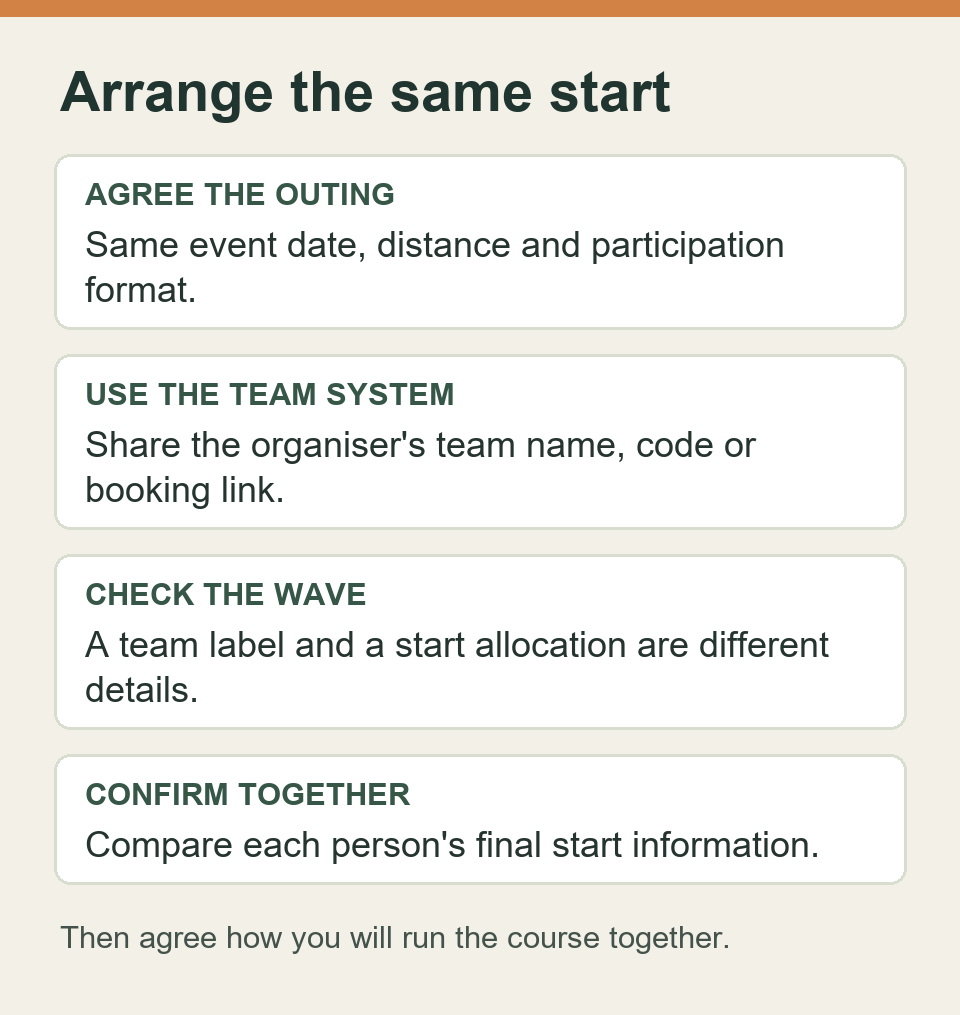
Use the organiser’s team process and check each person’s final allocation.
Organiser
What its current guidance says
Practical consequence
Tough Mudder
Team members wanting the same start must select the same wave. Team changes have a stated deadline.
Creating a team is not a reason to ignore each person’s wave selection.
Wolf Run
Using the same Pack Code links entries to the same start time.
Share the code before friends enter; use the FAQ process if already booked separately.
Spartan
Teams need the same time block for grouping; preferred starts are subject to allocation.
Check the time block as well as the team and heat.
Nuclear
A formal team needs at least five people; the captain can reserve its wave under the booking conditions.
Have everyone follow that reservation process rather than independently choosing a nearby time.
Total Warrior
A team needs at least four people. Later entrants join its wave if space is available.
Check capacity before assuming a later entrant can join you.
One person can circulate the exact event link, date, distance, format, team code and wave everyone has agreed. Before travel, compare the final start information in each person’s confirmation.
Choose a plan the whole group understands
For a first shared outing, a useful brief is: “We want an ordinary participation format, a distance everyone chooses willingly, permitted alternatives for the features we dislike, and time to finish together.” Take that brief to the event comparison rather than choosing a brand first and persuading reluctant friends afterwards.
For a group travelling together, agree where to meet after different finish times and where each person’s clean clothes will be. The post-race change-bag guide covers keeping the dry return kit useful when everyone is muddy.