Some links in my articles are affiliate links. I may earn a commission when you buy through them.
Choose your first mountain-marathon course around the slower member of your pair, the navigation you can both manage and the load you will carry for two days. For Saunders, Wansfell and Harter Fell are starting points to investigate if you already have suitable hill and navigation experience. A score course gives you more control over distance, but its entry requirements can still be demanding.
The comparison below uses organiser information checked on 3 November 2026. Saunders is advertising 10–11 July 2027 in the North West Lake District. The OMM example is its completed 24–25 October 2026 event at Talnotry, Scotland; it explains a different course format, rather than promising the same options for its next edition.
A line course sets the checkpoints and their order; you work out how to travel between them. A score course lets you choose controls for points within a time allowance. Both can involve rough ground, climbing and finding small features away from paths.
Published example
What is specified
What to consider
Saunders Wansfell
Line course; around 27km and 2,200m ascent across two days.
A first-timer option for people with the required hill and navigation skills.
Saunders Harter Fell
Line course; around 31km and 2,550m ascent across two days.
A longer first-timer option; compare the added ground with your pair’s experience.
Saunders Fairfield
Score course; seven hours on Saturday and five on Sunday.
An experienced category, despite the freedom to choose your route.
OMM 2026 Short Score
Five hours on day one and four on day two.
The organiser’s suggested first-OMM option, with map-and-compass skills still needed.
Saunders says its current distances represent the planner’s best actual route. Its pre-2023 figures were straight-line distances. The displayed OMM 2026 linear-course examples use straight-line distances between controls. Those two measures cannot be compared as if they were marked trail-race lengths.
Even a best-route figure will not describe your exact outing. A permitted path round a slope may suit your pair better than a more direct crossing, and a navigation error adds travel without advancing the course. Read the terrain description and map restrictions before deciding that the shorter number will be quicker.
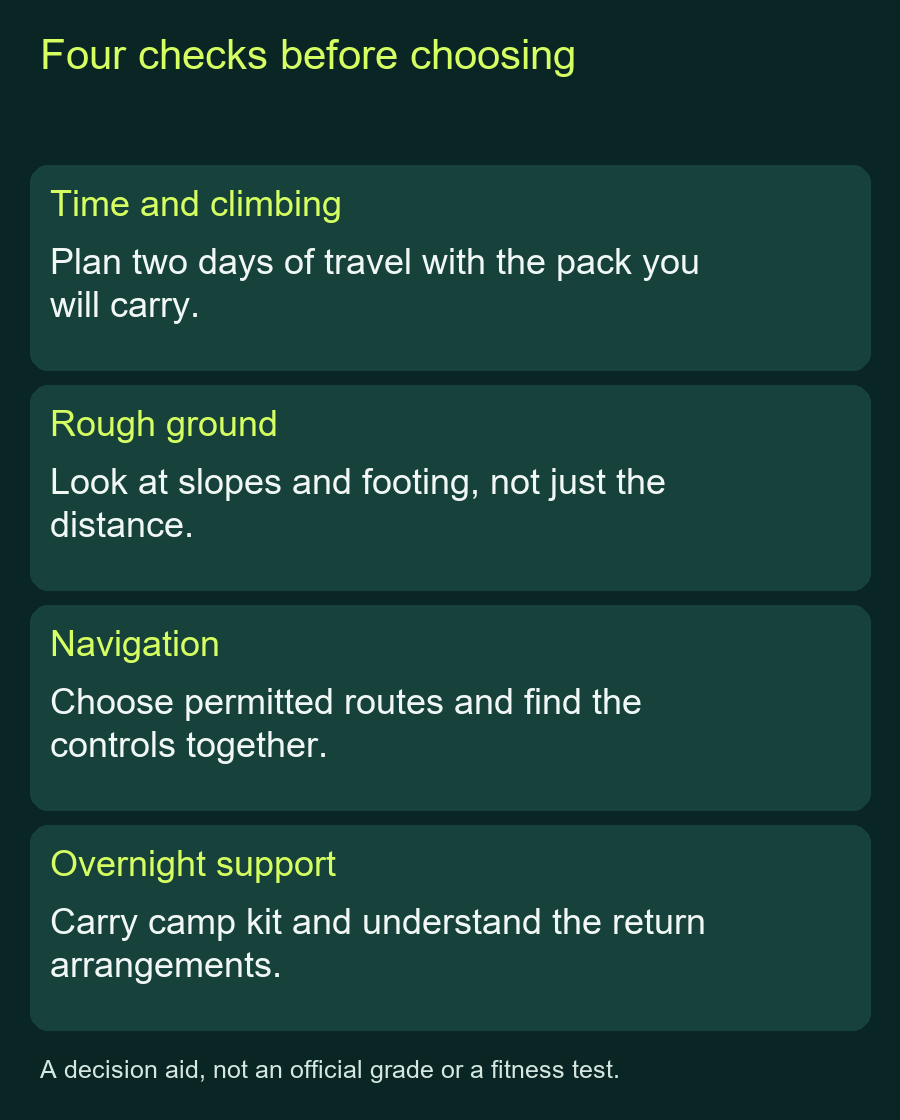
Keep four demands separate: the hours and climbing, the footing and descents, the navigation, and how far you are from ordinary support. The Saunders overview describes substantial off-trail travel and uneven slopes. Familiarity with a runnable forest trail does not establish the same confidence on that ground.
The name mountain marathon also does not promise a road-marathon distance. Look at the exact course totals, how the two days are divided and the pack you will be carrying.
Score gives choice, not easy navigation
The useful freedom is deciding which controls to leave out. You can build a modest plan, then reassess it as your pace and the ground become clearer. You also take on the job of choosing a sensible sequence and leaving time to reach the required finish.
OMM recommended Short Score to first-time competitors in its 2026 information. Saunders describes Fairfield as needing good mountain navigation from both partners and previous mountain-marathon or equivalent experience from at least one.
For Fairfield, a control visited on Saturday cannot earn points again on Sunday. Consider which controls to save for Sunday when planning Saturday’s route to camp.
If your experience is following signs or a line on a watch, start by learning conventional map-and-compass navigation. The first orienteering course guide explains how to find an appropriate introduction. Phone-based MapRun arrangements described there do not transfer to these mountain-marathon rules.
Choose for the pair you will be
Discuss your usual pace on rough climbs and descents, how you make navigation decisions and what each person wants from the weekend. One runner hoping for a competitive result and another wanting a steady first finish need to settle that difference before choosing a class.
A useful practice outing uses the intended packs and a route within both people’s abilities. Take turns making the navigation decisions. Notice whether you can read the map, adjust clothing and eat without the other person repeatedly waiting or taking over. Use what happens to choose your course and divide the load.
The Saunders rules require the pair to stay within voice and visual contact with their equipment. OMM’s displayed 2026 rules also keep the team and its bags together. This is not a relay in which the stronger runner can collect a distant control while their partner rests.
Four separate planning questions; not an official course grade or a fitness test.
Check the night and Sunday before entering
Read the mandatory equipment list with your partner, including what each person must have and what the team shares. Then work out whether you can carry, use and repack it. The overnight mountain-marathon camp guide explains the support and practical tasks that sit between the running days.
Check the current entry conditions too. At our check, the Saunders course table listed Fairfield’s minimum age as 16, while its rules page said 18. Ask the organiser to resolve that before planning a junior entry. Do not assume a course name or a past result settles eligibility.
Before committing, put the course choice into a specific question: “We can navigate on open hills and have tried our loaded packs together. We want a steady first weekend rather than the longest route. Which course fits, and what final instructions should we read?” Include any gaps in your experience, then use the exact edition’s maps, closing times and kit requirements when they are issued.